

A first-time Driving While Intoxicated (DWI) charge in Texas can be an incredibly daunting experience.
The fear of the unknown, particularly the possibility of jail time, weighs heavily on anyone facing such accusations.
Texas has a reputation for being tough on crime, and DWI offenses are no exception.
However, the question of whether jail time is mandatory for a first DWI in Texas is not always a straightforward “yes” or “no.”
While the law outlines potential jail sentences, various factors, including the specific circumstances of your case and, crucially, the expertise of your legal representation, can significantly influence the outcome.
This comprehensive guide will delve into the intricacies of Texas DWI laws for first offenders, exploring the potential penalties, factors that can aggravate a sentence, and alternative sentencing options.
What are the Standard Penalties for a 1st DWI in Texas?

A first-offense DWI in Texas is typically classified as a Class B Misdemeanor.
This classification comes with a range of potential penalties, as outlined in the Texas Penal Code.
Understanding these baseline consequences is crucial for anyone facing a DWI charge.
Generally, the standard penalties for a first-time DWI conviction in Texas can include:
Fines
Up to $2,000. It’s important to note that this is just the base fine; additional court costs, surcharges, and fees for programs can significantly increase the total financial burden.
Jail Time
While not always mandatory for the full duration, the law allows for a jail sentence of 72 hours (3 days) to 180 days in county jail. We’ll discuss the nuances of this “mandatory” aspect shortly.
Driver’s License Suspension
A suspension of your driver’s license for 90 days to one year. This suspension is separate from any administrative license revocation (ALR) that may occur after arrest.
DWI Education Program
Mandatory completion of a state-approved DWI education program. Failure to complete this program can lead to an additional license suspension.
Annual Surcharges
For three years, you may face an annual surcharge of $1,000 or $2,000 to retain your driver’s license through the Texas Department of Public Safety’s Driver Responsibility Program.
Community Service
The court may impose community service hours, typically ranging from 24 to 100 hours.
It’s essential to recognize that these are the potential penalties.
The actual outcome of your case can vary widely depending on the specifics and the effectiveness of your defense.
Is Jail Time Truly Mandatory for a First DWI in Texas?

This is perhaps the most pressing question for many facing a first DWI, and the answer is nuanced.
While Texas law allows for jail time for a first-offense DWI, it is not always mandatory that you serve the full potential sentence, or any jail time at all, especially if you are granted probation or deferred adjudication.
Here’s the breakdown:
Mandatory Minimums (in some cases)
For a standard first-offense DWI, if convicted and not granted probation, there can be a mandatory minimum of 72 hours (three days) in county jail.
However, this minimum can often be satisfied through alternative means as part of a plea agreement or probation terms.
Probation and Deferred Adjudication
In many first-time DWI cases, particularly those without aggravating factors, defendants may be eligible for community supervision, commonly known as probation.
If granted probation, you typically would not serve jail time as long as you comply with the conditions of your probation.
These conditions often include regular reporting to a probation officer, attending alcohol education or treatment programs, community service, avoiding further criminal offenses, and maintaining employment.
Deferred Adjudication
This is a particularly favorable outcome where, if you successfully complete the terms of your probation, your DWI charge can be dismissed, allowing you to avoid a permanent conviction on your record.
This is a significant advantage in avoiding future repercussions on employment, housing, and other aspects of life.
Jail as a Condition of Probation
Even if you are granted probation, some judges may still impose a short period of jail time (e.g., 3-5 days) as a condition of that probation.
This is often referred to as “shock probation” or “terms and conditions” (T&C) jail time, and it serves as a deterrent and a reminder of the seriousness of the offense.
Aggravating Factors
The likelihood of serving significant jail time increases dramatically if there are aggravating factors involved in your DWI case.
The key takeaway is that while jail time is a possibility and a minimum might apply if probation isn’t granted, a seasoned DWI attorney can work to minimize or eliminate actual time behind bars by pursuing options like probation, deferred adjudication, or negotiating a favorable plea bargain.
What Factors Can Influence Jail Time for a 1st DWI?

Several factors can influence the severity of the penalties for a first DWI offense, including whether or not you will face jail time.
These “aggravating factors” can elevate a standard Class B Misdemeanor to a more serious charge, or simply lead to a harsher sentence within the misdemeanor framework.
Blood Alcohol Concentration (BAC) of 0.15% or Higher
If your BAC was 0.15% or more (nearly twice the legal limit of 0.08%), your first DWI can be elevated to a Class A Misdemeanor.
This carries significantly higher penalties, including fines up to $4,000 and jail time of up to one year.
Presence of an Open Container
If you had an open alcoholic container in your vehicle at the time of your arrest, even for a first offense, you face a mandatory minimum of six days in jail.
DWI with a Child Passenger (Under 15 years old)
This is a very serious aggravating factor.
If you are arrested for DWI with a child under the age of 15 in the vehicle, the charge is automatically elevated to a State Jail Felony.
The penalties for a State Jail Felony include a fine of up to $10,000 and a prison sentence of 180 days to two years in a state jail facility.
This also carries a potential loss of parental rights.
Accident Resulting in Injury or Death (Intoxication Assault/Manslaughter)
If your DWI resulted in an accident causing serious bodily injury to another person, you could be charged with Intoxication Assault, a Third-Degree Felony (2 to 10 years in prison, up to $10,000 fine).
If the accident resulted in a death, you could be charged with Intoxication Manslaughter, a Second-Degree Felony (2 to 20 years in prison, up to $10,000 fine).
These are severe felony charges with mandatory prison time.
Prior Criminal History
While this is a “first DWI,” a pre-existing criminal record, even for unrelated offenses, can influence a judge’s decision regarding sentencing and may make them less inclined to grant probation or lenient terms.
Refusal to Take a Chemical Test
While not a direct criminal penalty, refusing a breath or blood test results in an automatic administrative license suspension (ALR).
For a first refusal, your license will be suspended for 180 days, separate from any criminal penalties.
While it doesn’t directly mean more jail time, it can be viewed negatively by the prosecution and court.
Understanding these aggravating factors is crucial because they can drastically alter the trajectory of your case and the potential for jail time.
What are the Alternatives to Jail Time for a 1st DWI?
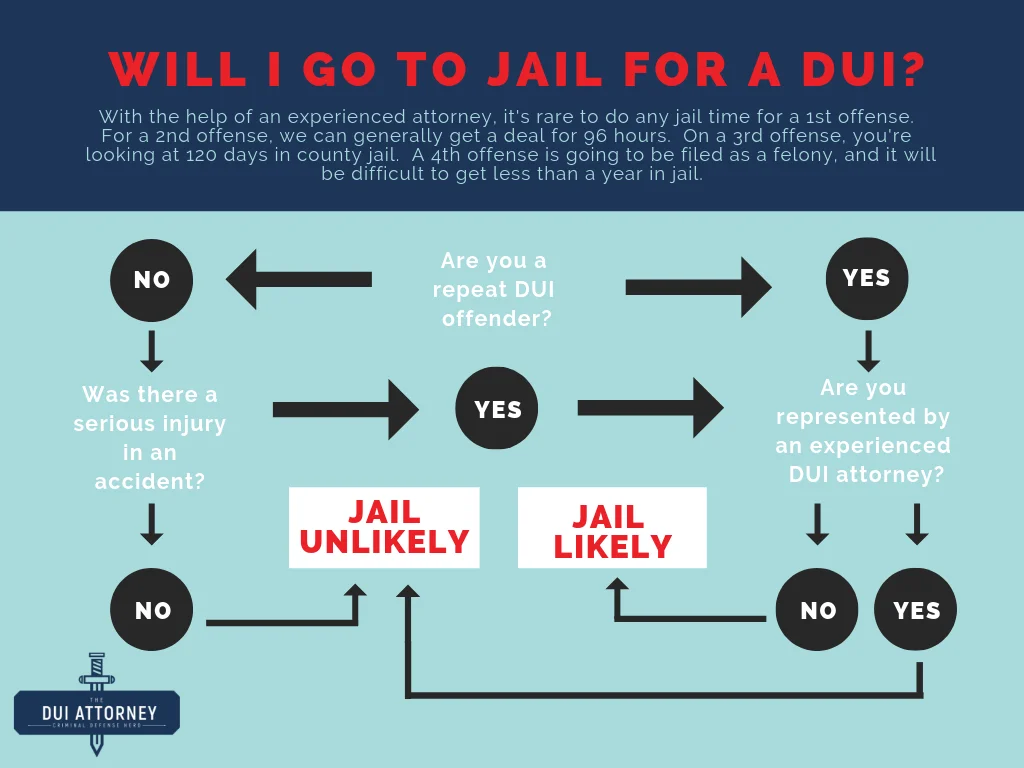
For many first-time DWI offenders in Texas, the goal is to avoid jail time.
Fortunately, the legal system offers several alternatives that an experienced attorney can pursue.
Probation (Community Supervision)
As mentioned, probation is the most common alternative to jail time for a first DWI.
It involves serving your sentence under the supervision of a probation officer, adhering to specific conditions, and completing required programs.
Successful completion leads to the avoidance of jail time.
Deferred Adjudication
This is a highly desirable outcome where, upon successful completion of a probationary period, the DWI charge is dismissed, and you avoid a conviction on your criminal record.
This is not always available for DWI cases in Texas but can be pursued in specific circumstances.
DWI Education and Treatment Programs
Courts often mandate participation in DWI education programs (e.g., a 12-hour DWI Education Course) and, if deemed necessary after an evaluation, alcohol or drug treatment programs.
These programs are designed to address the underlying issues of alcohol use and prevent future offenses.
Ignition Interlock Device (IID)
An IID is a breathalyzer device installed in your vehicle that prevents it from starting if it detects alcohol on your breath.
While often mandatory for repeat offenders, a judge may order an IID for a first offender, sometimes as a condition for avoiding jail time or to allow for restricted driving privileges.
Community Service
Performing community service hours is a common component of probation and serves as a form of restitution to the community.
Fines and Fees
While not an “alternative” in the sense of avoiding a penalty, the payment of fines and various fees is an unavoidable part of a DWI conviction.
The availability and suitability of these alternatives depend heavily on the specifics of your case, your criminal history, and, most importantly, the skill of your defense attorney in negotiating with the prosecution and presenting your case to the court.
How Can a DWI Lawyer Help You Avoid Jail Time?

Facing a DWI charge without legal representation is highly discouraged.
The Texas legal system is complex, and the consequences of a DWI conviction are severe and long-lasting.
A skilled DWI lawyer can be the difference between a favorable outcome and a life-altering conviction, particularly when it comes to avoiding jail time.
Here’s how an experienced DWI attorney can help:
Challenging the Arrest and Evidence
A good DWI lawyer will meticulously review every detail of your arrest, including the traffic stop, field sobriety tests, breathalyzer results, and blood tests.
They can identify procedural errors, constitutional violations, or flaws in the prosecution’s evidence that could lead to the suppression of evidence or even dismissal of the charges.
Probable Cause
Did the officer have a valid reason to stop your vehicle?
Field Sobriety Tests (FSTs)
Were the FSTs administered correctly? Are there physical or medical conditions that could have affected your performance?
Breath and Blood Tests
Were the testing devices calibrated correctly? Was the chain of custody for your blood sample maintained?
Were your rights to refuse or request an independent test properly explained?
Negotiating with the Prosecution
Many DWI cases are resolved through plea bargains.
An experienced attorney knows how to effectively negotiate with prosecutors, presenting mitigating factors and alternative sentencing options to achieve a reduced charge or a more lenient sentence that avoids or minimizes jail time.
They can advocate for probation, deferred adjudication, or a plea to a lesser offense.
Presenting Mitigating Factors
Your lawyer can present compelling arguments to the court about why jail time is not appropriate for your specific situation.
This could include your lack of prior criminal history, your employment, family responsibilities, and your willingness to undergo treatment or education.
Navigating the ALR Hearing
Your attorney can represent you at the Administrative License Revocation (ALR) hearing, which is separate from your criminal case, to challenge the automatic suspension of your driver’s license.
Preparing for Trial
While many cases are resolved through plea agreements, a skilled DWI lawyer will be prepared to take your case to trial if it’s in your best interest.
They will build a strong defense, present evidence, cross-examine witnesses, and argue for your innocence or for a lesser charge.
Guidance and Support
Beyond legal strategy, a DWI attorney provides invaluable guidance and support throughout the stressful legal process, explaining your rights, options, and what to expect at each stage.
What Happens If You Refuse a Chemical Test for a 1st DWI?

Refusing a breath or blood test after a DWI arrest in Texas triggers what is known as Administrative License Revocation (ALR).
This is a separate civil process handled by the Texas Department of Public Safety (DPS), distinct from your criminal DWI case.
Automatic License Suspension
For a first refusal, your driver’s license will be automatically suspended for 180 days.
This suspension takes effect 40 days after your arrest unless you request an ALR hearing within 15 days of the arrest.
The 15-Day Rule
This 15-day window to request an ALR hearing is critically important. If you miss this deadline, your license will be suspended automatically.
ALR Hearing
At an ALR hearing, your attorney can challenge the license suspension.
The hearing focuses on whether the officer had reasonable suspicion to stop you, probable cause to arrest you for DWI, and whether you were properly informed of the consequences of refusing the test.
Winning an ALR hearing can prevent or shorten your license suspension.
Impact on Criminal Case
While a refusal does not automatically lead to a criminal conviction or directly increase your jail time, the prosecution can use your refusal against you in the criminal DWI trial as evidence of your consciousness of guilt.
It’s a complex decision to refuse a chemical test, and it’s always best to consult with a DWI attorney immediately after an arrest to understand your rights and the potential consequences of such a refusal.
How Long Does a 1st DWI Case Take to Resolve in Texas?
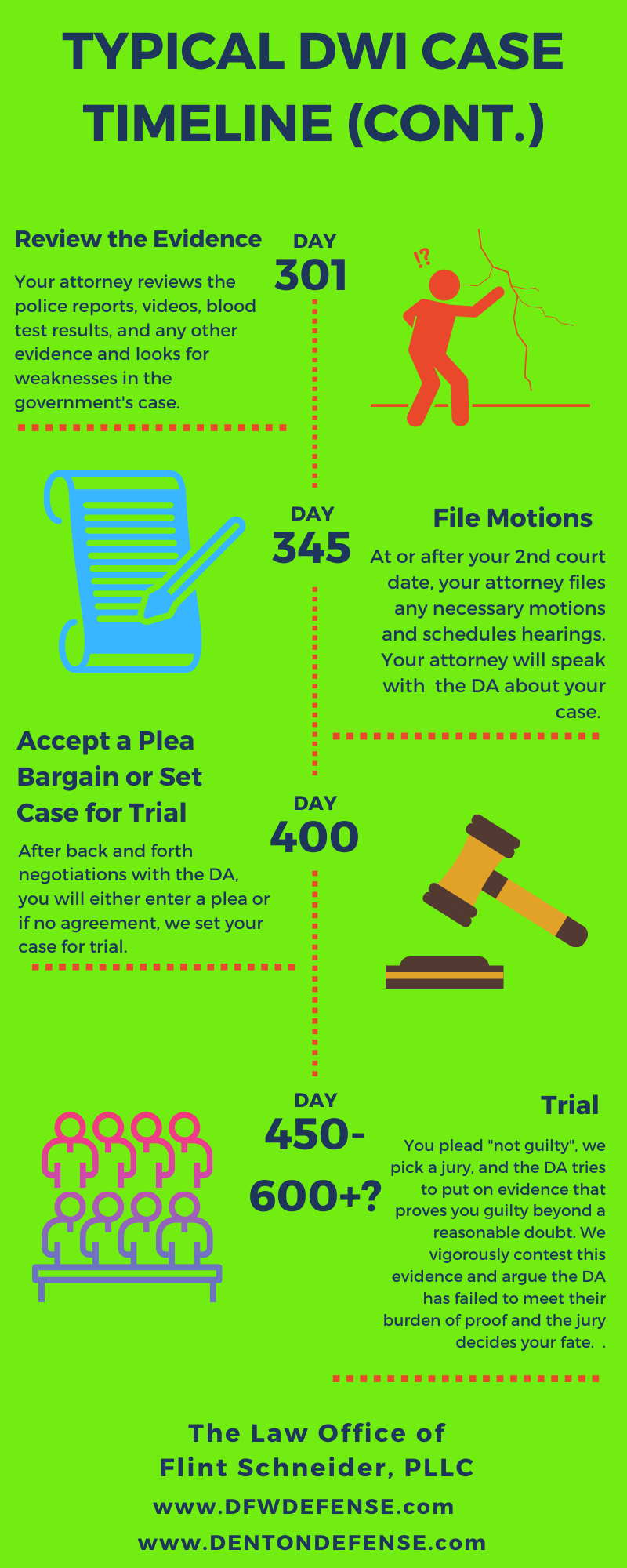
The time it takes to resolve a first-offense DWI case in Texas can vary significantly, ranging from a few months to over a year, depending on several factors:
Case Complexity
Simple cases with clear evidence and no significant disputes may be resolved more quickly.
Cases involving accidents, injuries, challenging evidence, or intricate legal arguments will naturally take longer.
Court Docket and Caseload
The volume of cases in a particular court and the judge’s schedule can impact how quickly your case progresses.
Negotiation vs. Trial
If a plea agreement is reached relatively early in the process, the case can be resolved much faster than if it goes to trial.
Preparing for trial involves extensive discovery, motions, and court hearings, all of which take time.
Your Attorney’s Strategy
A proactive and strategic attorney can often move a case along efficiently, while a less experienced one might prolong the process unnecessarily.
Pre-Trial Hearings and Motions
There are often multiple pre-trial hearings, such as arraignment, bond hearings, and hearings on motions to suppress evidence. Each of these adds to the overall timeline.
Blood Test Results
If a blood test was taken, waiting for the lab results can significantly delay the process, as these can take several weeks or even months to come back.
While the desire for a quick resolution is understandable, it’s often beneficial for your attorney to take the necessary time to build the strongest possible defense.
Rushing the process could lead to a less favorable outcome.
What are the Long-Term Consequences of a 1st DWI Conviction?

Even if you avoid jail time, a first DWI conviction in Texas carries significant long-term consequences that can impact various aspects of your life:
Criminal Record
A DWI conviction creates a permanent criminal record, which can appear on background checks for employment, housing, and educational opportunities.
This can make it difficult to secure jobs, rent apartments, or be accepted into certain academic programs.
Increased Insurance Rates
Your auto insurance premiums will almost certainly skyrocket after a DWI conviction, potentially costing you thousands of dollars over several years.
Professional Licenses
For certain professions (e.g., healthcare, education, law, commercial driving), a DWI conviction can lead to the suspension or revocation of your professional license.
Immigration Consequences
For non-citizens, a DWI conviction can have severe immigration consequences, including denial of visas, green cards, or even deportation.
Social Stigma
A DWI conviction can carry a social stigma, impacting your reputation and relationships.
Travel Restrictions
Some countries may deny entry to individuals with a criminal record, including DWI convictions.
These long-term consequences underscore the critical importance of fighting a DWI charge with experienced legal counsel. Adrian Chapa, the Texas Trophy Lawyer, understands the full scope of these ramifications and works tirelessly to mitigate them for his clients.
Conclusion: Don’t Face a DWI Alone – Call Adrian Chapa

A first-offense DWI in Texas is a serious legal matter with potentially severe consequences, including jail time.
While jail is not always mandatory for a first offense, especially if probation or deferred adjudication is granted, the potential for incarceration increases significantly with aggravating factors.
The legal landscape surrounding DWIs is complex and requires a deep understanding of Texas law, court procedures, and effective defense strategies.
Attempting to navigate a DWI charge on your own is a high-stakes gamble that can have devastating and lasting repercussions on your freedom, finances, and future.
The best defense is a proactive and experienced one.
If you find yourself facing a DWI charge in Texas, the most crucial step you can take is to immediately contact a skilled and dedicated DWI attorney.
For unparalleled legal representation, strategic defense, and a relentless commitment to protecting your rights, look no further than Adrian Chapa, the Texas Trophy Lawyer out of Laredo, Texas.
His extensive experience, profound knowledge of Texas DWI laws, and proven track record make him the ideal advocate for anyone seeking to avoid jail time and minimize the long-term impact of a DWI charge.
Don’t delay; secure the powerful legal defense you deserve.